
I didn’t plan to think this much about transportation when I first went to Bali.
Honestly, I thought it would be simple. You arrive, you move around, you leave. That’s usually how trips work. But Bali has a way of turning small, practical things into something more noticeable. After a few days, I realized that getting around Bali wasn’t just something I was doing in the background. It was shaping how each day felt, sometimes more than the places themselves.
There were mornings when everything flowed. And others when nothing did. No clear reason. Same roads. Same distance. Different outcome.
The First Ride Is Always Strange
The drive from the airport doesn’t ease you in. It throws you straight into it. Heat, noise, movement everywhere. Drivers weaving through spaces that don’t look wide enough. Cars stopping without warning.
I remember watching the road and thinking, “This shouldn’t work.” But it did. And it kept doing that.
That first ride quietly introduces you to the logic of getting around Bali. Not rules, exactly. More like agreements. Everyone seems to know what the other person is about to do, even when it looks messy from the outside.
You don’t understand it yet, but you start adapting.
Distances Stop Making Sense
At some point, you stop asking how far something is.
Ten kilometers doesn’t mean anything. Neither does twenty. A short line on a map can turn into a long afternoon. Or not. It depends on things you don’t control. Ceremonies. Rain. School traffic. Sometimes just timing.
This is where expectations break down. And that breakdown is important. Because once you accept that, getting around Bali becomes less frustrating. You stop fighting the island’s pace.
You leave earlier. Or later. Sometimes it doesn’t matter.
About Motorbikes (And Why They Divide People)
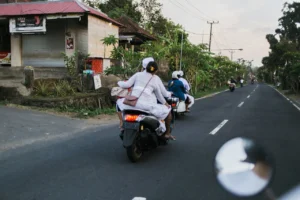
Motorbikes look like the answer. And sometimes they are.
They’re everywhere. They move easily. They don’t get stuck the same way cars do. For many travelers, they feel like freedom.
For others, they feel like constant tension.
Motorbikes are one of the most common transportation options in Bali, but they demand attention in a way not everyone enjoys. The road is close. Very close. You feel every surface change. Every decision matters.
Some people thrive on that awareness. Others realize quickly it’s not for them. Both reactions are completely normal.
Drivers Change the Day
Hiring a driver changes how a day unfolds.
There’s less urgency. Less mental noise. You stop scanning the road and start watching life around it. Shops opening. Offerings being placed. Kids heading home from school.
This became my preferred way of getting around Bali, especially when days were long. Not because it was faster. Often it wasn’t. But it was easier on the mind.
Among all transportation options in Bali, this one quietly gives you space. Space to think. Or not think at all.
Sometimes the driver talks. Sometimes they don’t. Both are fine.
Apps Work, Until Reality Interrupts
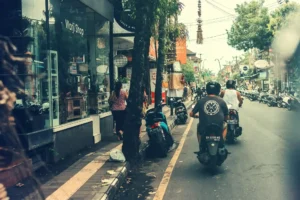
Ride-hailing apps are useful. No question. They’re convenient. Prices are clear. You know what you’re agreeing to.
But Bali doesn’t always follow app logic.
Certain areas restrict pickups. Drivers ask you to walk a little. Or a lot. Sometimes a ride gets canceled and you’re not sure why.
These moments can be irritating if you expect consistency. But if you accept them, they become part of getting around Bali. You learn to read situations, not just screens.
Apps remain important transportation options in Bali, just not the only ones.
Walking Is Situational
Walking in Bali is either wonderful or exhausting. There’s rarely a middle ground.
Some streets invite slow wandering. Others feel like they’re pushing you back into traffic. Sidewalks appear, disappear, reappear. You adjust.
But when walking works, it slows time. You notice small things. The smell of incense. The sound of a radio from a nearby shop. Offerings on the ground that force you to look down.
Walking doesn’t feel efficient. But efficiency isn’t always the point.
A Few Small Things People Rarely Mention
There are little moments that never make it into travel guides.
Like standing on the side of the road, unsure whether to cross, while traffic somehow flows around you instead of stopping. Or sitting in the back seat during a sudden rainstorm, windows fogging up, the road slowing to a crawl, no one complaining.
I remember one afternoon when everything ran late. Lunch was delayed. A meeting point shifted. The sun moved faster than expected. Normally, that would have bothered me. That day, it didn’t. I watched offerings being placed on the road, drivers waiting patiently, nobody checking a watch too often.
When Timing Stops Feeling Important
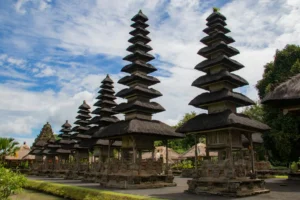
That’s when it clicked that movement here isn’t meant to be efficient. It’s meant to be lived through, shaped quietly by the many transportation options in Bali that invite patience rather than speed.
Sometimes you plan carefully and still arrive late. Sometimes you leave with no plan and end up exactly where you need to be. Bali doesn’t seem interested in rewarding control. It responds better to attention, especially when you begin to understand how transportation options in Bali move at their own rhythm.
There’s also a strange comfort in repetition. Taking the same road multiple times. Recognizing a turn before it appears. Knowing when traffic will thicken without looking at a map. These things don’t happen instantly. They arrive slowly, almost without you noticing, through daily familiarity with the transportation options in Bali and the quiet patterns of getting around Bali.
By the end of a longer stay, moving around stops feeling like travel. It starts feeling routine. Familiar. Almost domestic. Getting around Bali no longer feels like navigation, but like habit. You no longer feel like a guest passing through, but someone temporarily woven into the daily rhythm.
And maybe that’s why leaving feels heavier than expected.
Not because of the places you didn’t see, but because of the movement you grew used to. The pauses. The waiting. The way time bent without breaking.
Those aren’t things you photograph.
But they’re what stay with you.
What Stays With You After You Leave
Even after you leave, that feeling lingers.
Back home, movement feels louder. Faster. More impatient. You notice how often people rush without knowing why. You remember how different it felt when delays didn’t automatically mean stress, when waiting was just part of the day instead of a problem to solve.
Bali quietly rewires that instinct.
It doesn’t teach you new routes or shortcuts. It teaches you tolerance for uncertainty. An ability to pause without panicking. To arrive a little later and still feel fine about it.
Those lessons don’t fade quickly.
Long after the trip ends, they show up in small ways—when you stop rushing, when you breathe through delays, when you realize that sometimes the way you move matters more than where you’re trying to go.