
The strange thing about Bali is that it doesn’t try to explain itself. It just keeps going. At first, I was busy noticing the obvious things. The views. The smells. The colors. It took time before I started paying attention to what actually filled the days. That quiet routine, repeated again and again, is where Balinese daily life really lives.
Not in the highlights. Not in the moments people line up to photograph. But in everything that happens in between.
Mornings That Feel Lived In
There’s no sharp beginning to the day. No dramatic shift from night to morning. You just wake up and realize things have already started moving. Someone has swept the ground. Someone else has passed by your gate. You hear soft voices, not loud ones.
Offerings appear almost without effort. They’re not symmetrical. Some look rushed. Some look like they were made while someone was thinking about something else entirely. That’s what made me pause. This wasn’t performance. This was habit.
In Balinese daily life and traditions, spirituality isn’t scheduled. It’s folded into whatever else is happening that morning.
Family as a Daily Presence
One thing that becomes clear quickly is how close everyone lives to each other. Not emotionally—physically. Multiple generations sharing the same space, the same yard, the same routines. Privacy exists, but it’s flexible.
In Balinese daily life, family isn’t something you “check in with.” It’s simply there. You eat when food is ready and you help because you’re nearby. You don’t need to announce it.
This closeness is one reason Balinese daily life and traditions continue without much effort. No one needs reminders. Children grow up watching, listening, absorbing.
Work Without the Rush
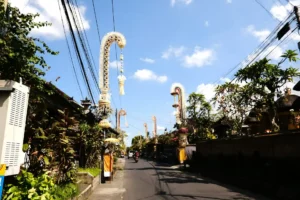
People work hard here. That part surprised me. Long hours, physical labor, constant movement. But what’s missing is urgency for urgency’s sake.
Someone might stop working mid-task because something else matters more at that moment. A ceremony. A neighbor. A family responsibility. In Balinese daily life, work bends when it needs to.
That flexibility isn’t chaos. It’s an unspoken agreement shaped by Balinese daily life and traditions—life is layered, not linear.
Ceremonies Are Part of the Background
At first, ceremonies feel disruptive. Roads close. Traffic slows. Plans change. But after a while, they fade into the background in a strange way.
You stop seeing them as interruptions and start seeing them as markers. Like punctuation in a long sentence. In Balinese daily life, these moments don’t stop time. They shape it.
This repetition is how Balinese daily life and traditions stay grounded. Nothing is rare, so nothing feels fragile.
Meals Are Simple, Moments Are Not
Most meals are uncomplicated. Rice. Vegetables. Something fried. Something spicy. No one makes a big deal out of it.
But people don’t eat alone much. Someone always sits nearby. Someone always talks. In Balinese daily life, food creates pauses, not events.
That casual togetherness is one of the quiet carriers of Balinese daily life and traditions. Nothing formal. Nothing forced.
Children Learn Without Being Taught
I rarely saw adults explaining things to children. Instead, children followed. They carried things that were too big. They stood quietly longer than you’d expect.
In Balinese daily life, learning is observational. Kids absorb rhythm before meaning. Action before explanation.
This is why Balinese daily life and traditions feel resilient. They aren’t preserved. They’re practiced.
Modern Life Slips In Gently
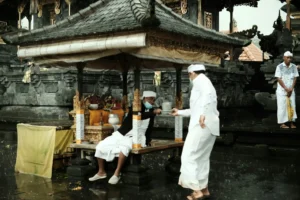
Phones are everywhere. Motorbikes are louder than prayers sometimes. Cafés serve drinks you’d expect to find anywhere else in the world.
But Balinese daily life doesn’t resist change. It accommodates it. Tradition doesn’t disappear—it adjusts its shape.
That flexibility is part of Balinese daily life and traditions, even if no one calls it that.
Evenings That Don’t Need Plans
As the day ends, things soften. People sit outside without purpose. Conversations start and stop naturally. No one checks the time too often.
In Balinese daily life, evenings feel earned. Not because something productive happened, but because the day unfolded fully.
And that sense—of a day being complete—is something Balinese daily life and traditions quietly teach.
Learning to Be Less Urgent
Sometimes the biggest lessons come from waiting. Waiting while a prayer finishes, waiting while people gather, waiting without filling the gap.
At first, it’s uncomfortable. Later, it feels normal. In Balinese daily life, not everything demands a response.
That mindset shifts something. You become less reactive. Less impatient. More present.
What Stays With You
Leaving Bali always feels louder than arriving. People rush. Conversations overlap. Silence feels awkward again.
What stays isn’t a rule or a ritual. It’s the feeling that life doesn’t need to be tightly managed to feel meaningful.
That’s the quiet power behind Balinese daily life and traditions. They don’t ask to be admired. They just keep going, steady and grounded, day after ordinary day.
The Space Between Moments
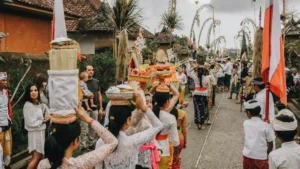
There’s a certain kind of space that exists here, and it’s hard to describe unless you’ve felt it. It’s the space between activities. Between conversations. Between intention and action. In many places, that space feels uncomfortable, like something is missing. In Bali, it feels intentional.
You notice it when someone pauses before answering a question, not because they don’t know the answer, but because they’re choosing their words carefully. You notice it when a task takes longer than expected and no one seems bothered by it. Time stretches, then settles.
I didn’t realize how tightly I managed my own days until I stopped needing to. Back home, even rest felt scheduled. Here, rest happened naturally. It arrived without being invited.
When Nothing Special Is Happening
Some of the most memorable days were the ones where nothing stood out. No trips, no ceremonies, no plans at all. Just ordinary hours passing slowly.
I would sit somewhere shaded and watch people come and go. Someone fixing a motorbike. Someone laughing at something I couldn’t hear. A dog sleeping through the afternoon like it had nowhere else to be.
Those were the days that quietly reset something inside me. They reminded me that life doesn’t always need highlights to feel full.
Leaving Without Really Leaving
Even after you go, pieces of this rhythm follow you. You catch yourself slowing down when you don’t need to. Letting silences sit a little longer. Not filling every pause with noise or distraction.
It’s subtle, but it stays.
You start measuring days differently. Not by how much you accomplished, but by how present you were. By whether you noticed small things. By whether you allowed moments to finish naturally.
And that might be the most unexpected thing Bali gives you. Not a memory you replay, but a habit you carry forward. One that gently reminds you, even far from the island, that a quieter pace is not a loss of momentum.
Sometimes, it’s exactly what makes life feel whole.