
I didn’t wake up that day thinking I would visit Ubud Monkey Forest. It wasn’t written on my plan and it wasn’t circled on a map. It came up casually, the way good ideas often do, in the middle of a conversation that had nothing to do with schedules. Someone mentioned it softly, almost like a suggestion you’re free to ignore. I didn’t ignore it. And I’m glad I didn’t.
This isn’t the kind of place you “do.” It’s the kind of place you enter, and something shifts without you noticing right away. That’s why this isn’t written like a formal guide. Think of it more as an Ubud Monkey Forest visitor guide told the way friends talk—slowly, honestly, with small pauses where memories sit.
The Moment the Noise Fades
The first thing I remember is not seeing a monkey. It’s the sound disappearing. Ubud is lively. Motorbikes, voices, movement. Then suddenly, you step forward and the volume lowers, like someone gently turned a knob. Trees take over the skyline. Stone replaces concrete.
That transition matters more than people realize. Ubud Monkey Forest doesn’t announce itself with drama. It lets you arrive quietly.
Walking Without Direction
I didn’t follow a route and I didn’t check a map. I walked where the path curved and stopped where something felt interesting. Roots crossed the ground like veins. Statues leaned slightly, softened by moss and time.
This is where many guides become too instructional. A real Ubud Monkey Forest visitor guide should say this instead: you don’t need a plan here. Wandering works better.
Seeing the Monkeys as Neighbors, Not Performers
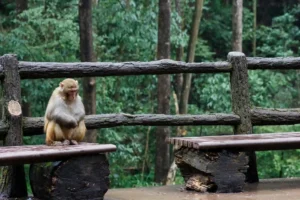
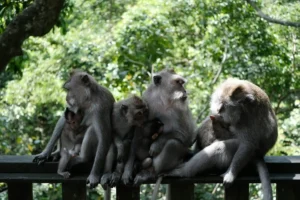
When I finally noticed the monkeys, they weren’t doing anything remarkable. One sat alone, looking mildly bored. Another groomed its companion with focus that felt almost meditative. A few younger ones tested boundaries, then lost interest.
They weren’t performing. They were living. That’s the key difference. In Ubud Monkey Forest, you’re not watching a show. You’re observing a community that happens to allow you nearby.
Learning Through Stillness
At some point, I stopped moving and just stood. No reason. No photo. Just standing. That’s when the forest opens up. You start noticing layers—the way leaves move independently, the way light shifts slowly across stone.
This isn’t something you can rush, and no Ubud Monkey Forest visitor guide can schedule it for you. It happens when you stop trying to “get something” from the place.
Temples That Don’t Feel Preserved
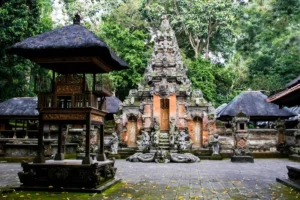
The temples inside the forest don’t feel like historical exhibits. They feel used. Real. Offerings appear quietly and disappear just as quietly. Stones are worn smooth where hands and feet have passed for generations.
Being there made me more aware of my presence. Not in a nervous way. Just attentive. Respect becomes instinctive in Ubud Monkey Forest, not enforced.
Things No One Explains Properly
Yes, you should secure your belongings. Yes, you shouldn’t bring food. But beyond those basics, there’s something harder to explain: intention matters here. The monkeys notice posture, movement, hesitation.
Most Ubud Monkey Forest visitor guide lists rules. Few talk about awareness. Calm doesn’t just keep you safe—it shapes the entire experience.
When Time Becomes Less Important
I couldn’t tell you how long I stayed. My phone stayed in my pocket. There was no internal clock pushing me forward. That’s rare, especially when traveling.
In Ubud Monkey Forest, time doesn’t disappear. It softens. It stretches just enough to remind you that not every moment needs documenting.
Watching Without Needing Proof
I took some photos early on. Then I stopped. Not because I was told to, but because it felt unnecessary. Some moments are complete without evidence.
A monkey sitting perfectly still. Leaves moving overhead. A quiet corner where nothing happened, yet everything felt full.
The Quiet Role of the People Who Work There
Staff members are present, but they don’t interrupt the mood. They observe. They understand the balance between human curiosity and animal space.
That balance is something many places try to manufacture. Ubud Monkey Forest seems to understand it naturally.
Leaving Feels Subtle, Not Final
When I walked back toward the exit, the outside world returned gradually. Sound first. Then movement. Then urgency. The forest didn’t push me out. It simply let me go.
That’s why Ubud Monkey Forest stays in your thoughts longer than expected. It doesn’t demand attention. It earns it quietly.
How This Experience Changes the Rest of Your Day
After leaving, everything else felt faster. Cafés were louder. Streets busier. Not in a bad way—just noticeable. The contrast sharpened my awareness.
A thoughtful Ubud Monkey Forest visitor guide should mention this transition. The forest doesn’t end at the gate. It lingers.
Small Details People Usually Walk Past
There are moments in the forest that don’t announce themselves. They don’t wave or make noise. You notice them only if you slow down enough. A cracked statue partially hidden by vines. A fallen leaf resting perfectly on stone. The way sunlight breaks through the canopy in uneven patterns.
These details don’t show up in photos very well. They aren’t dramatic. But they shape the atmosphere more than the obvious highlights ever could. I remember standing near a quiet corner, watching ants move methodically across a root thicker than my arm. Nothing special was happening, yet it felt complete.
Places like this reward attention, not effort. You don’t have to search. You just have to stop trying to consume the experience and let it come to you. That shift—from doing to noticing—is subtle, but it’s often what people remember most afterward, even if they can’t explain why.
What You Carry With You After Leaving
Long after the walk ends, something lingers. Not excitement. Not adrenaline. Something calmer. I noticed it later that day, sitting somewhere noisy and crowded, when my shoulders dropped without thinking. The pace I had borrowed from the forest stayed with me longer than expected.
That’s the quiet power of experiences that don’t try to impress you. They don’t compete for attention. They don’t demand reactions. Instead, they offer space. And space, when you’re not used to it, can feel surprisingly generous.
Travel often fills our minds. This place did the opposite. It emptied something out. It reminded me that not every meaningful moment needs a story attached to it. Some moments just need to be felt, then carried quietly into whatever comes next.
Final Thoughts, Spoken Softly
If you treat this place like a checklist item, it will feel like one. If you treat it like a shared space—entered with patience and curiosity—it gives something back that’s hard to name.
This isn’t a perfect guide. It’s a human one. And that’s exactly how Ubud Monkey Forest deserves to be remembered, and how this Ubud Monkey Forest visitor guide was meant to be shared.