
I didn’t come to Bali planning to understand anything deep. Honestly, I thought I would just walk around, eat well, maybe get a little sunburn, then go home with photos and stories that slowly fade. That’s usually how trips go for me.
But Bali didn’t really care about my plans.
There’s something about arriving on the island that feels slightly disorienting, even if you’ve traveled a lot. The air feels heavier. Sounds linger longer. Even small movements seem deliberate, as if people are constantly aware of where they place their feet and their attention.
The first thing that confused me wasn’t a big ceremony. It was the pauses. People stopping for a moment before entering a shop. Someone kneeling by the roadside early in the morning. Traffic slowing down without frustration. I remember thinking I was missing something obvious.
I was.
Understanding Balinese ceremonies doesn’t arrive in one clean realization. It shows up slowly, sometimes when you’re not paying attention, and even then it never feels complete. I might be wrong here, but that incompleteness feels intentional.
The Feeling That Something Is Always Happening
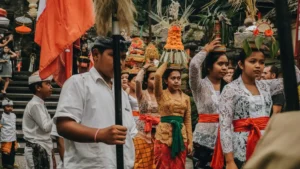
Bali feels busy and calm at the same time, which sounds contradictory, but it’s not. Or maybe it is. You hear music from a temple while someone next to you scrolls through their phone. Life doesn’t stop for ceremonies.
But it also doesn’t override them.
Sometimes you’re walking with no particular destination and suddenly realize you’ve slowed down without deciding to. It’s not because something blocked your path. It’s because everyone else did too.
Ceremonies don’t announce themselves. Sometimes you only realize what’s happening because everyone else already knows. Shops close without explanation. Roads are blocked without signs. And somehow, nobody is in a hurry.
People often want Balinese religious ceremonies explained logically. Step one, step two, meaning, conclusion. That approach helps a little. Not much. Bali doesn’t reward efficiency.
Anyway.
Small Offerings, Repeated Again and Again
The offerings are impossible to miss and easy to ignore. Small palm-leaf baskets. Flowers. Rice. Incense. Sometimes they look fresh. Sometimes they look like they’ve been sitting there all day.
You step around them without thinking. Or sometimes you forget and feel slightly embarrassed afterward. Nobody scolds you. Life continues.
I used to wonder how people found the time. Then I realized that question didn’t really fit. The time wasn’t found. It was assumed.
This repetition is part of Balinese ceremonies, even if it doesn’t look ceremonial. It’s closer to habit than performance. You don’t applaud it, you don’t explain it.
You just do it.
When the Whole Village Moves Together
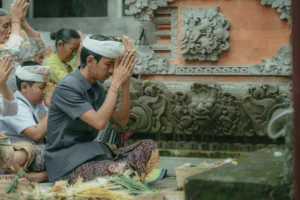
Some mornings feel different immediately. People dress differently. The air feels louder, then quieter. Music drifts in from somewhere you didn’t expect.
Temple ceremonies pull entire villages into motion. Preparation takes days. Sometimes longer. Offerings are adjusted, then adjusted again. Decorations are redone even when they already look fine.
There’s a lot of waiting involved. Waiting for people,waiting for timing, waiting for things to feel right. It doesn’t look rushed, but it’s not lazy either.
Watching this, you start to understand Balinese religious ceremonies explained not as belief, but as commitment. People show up when it’s inconvenient.
Especially then.
Life Is Marked, Even When It Feels Ordinary
In many places, life just continues without comment. In Bali, it’s marked. Birth, growing up, marriage. Even transitions that seem internal are acknowledged.
There’s comfort in that, I think. Knowing that change doesn’t happen unnoticed. That someone else recognizes it, even if quietly.
The tooth-filing ceremony stays with people. Teenagers lie there, unsure how to feel. Proud, nervous, bored. Sometimes all at once.
This is part of Balinese ceremonies that rarely makes it into travel guides. It’s not dramatic. It’s personal. And maybe a little uncomfortable.
That’s probably the point.
Death Looks Different Here, and That Takes Time to Accept
Cremation ceremonies confuse a lot of visitors. They look colorful. Almost celebratory. That contrast throws people off.
If you don’t know the context, it’s easy to misread the mood. Laughter can exist alongside grief. Movement can exist alongside loss.
Grief is still there. Of course it is. But the focus isn’t on holding on. It’s on helping the soul move forward. Families wait until the timing feels right.
This is one of those moments where Balinese religious ceremonies explained feels emotionally heavy. Or maybe heavy isn’t the right word. I didn’t fully get it at the time.
I’m not sure I do now.
Timing Is Not Flexible, and That’s the Point
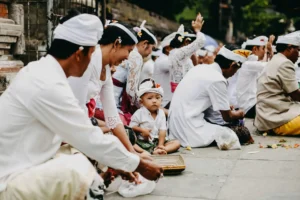
Time in Bali isn’t about clocks. It’s about calendars. Sacred days. Auspicious moments. Some days are fine for ceremonies. Others are not. At all.
You can feel this even as an outsider. Plans change. Schedules dissolve. And instead of frustration, there’s a strange acceptance in the air.
Priests help interpret this. If the timing is wrong, the answer is no. And that no doesn’t argue with anyone.
This gives Balinese ceremonies a quiet authority. Not loud. Not aggressive. Just… immovable.
Watching Without Fully Understanding
Visitors mostly watch from the edges. That’s expected. You’re not meant to participate fully. Sometimes you’re not meant to understand.
Standing there, slightly out of place, you realize explanations only go so far. This is where Balinese religious ceremonies explained stops being about information.
It becomes about presence.
And patience.
Modern Life Didn’t Replace These Traditions
People assume tourism changed everything. It didn’t. It added layers. Phones. Traffic. Schedules.
You might see someone checking messages between tasks, then returning to ritual without hesitation. The switch is smooth, almost practiced.
Ceremonies stayed.
Young people still show up. Sometimes distracted, sometimes proud, sometimes clearly tired. That mix feels real.
That’s why Balinese ceremonies still feel alive instead of staged.
The Part That Follows You Home
What stays with you isn’t always the big moments. It’s the pauses. The way people stop before doing ordinary things.
Later, somewhere else, you might slow down without realizing why. Light a candle. Take a breath. Hesitate before rushing.
That hesitation feels unfamiliar at first. Then comforting.
That’s maybe the most honest way Balinese religious ceremonies explained works. Not as something you master.
Just something that lingers.