
I used to plan trips like I was building a spreadsheet for a boss I didn’t even like. Wake up at 7, coffee at 7:20, beach at 8, temple at 10, lunch at 12, repeat. When I first came to Bali, I tried that again—because habits travel with you, unfortunately.
And then the island did that thing it does: it gently ignored my plan.
A road was half-closed. Someone was carrying offerings with the focus of a person doing something important. I heard gamelan in the distance and thought, “Is that a wedding? A rehearsal? Or am I just hearing things?” I remember standing there with a stupid little hesitation, like I was about to step into someone else’s living room.
That was my soft introduction to Balinese festivals—not as a headline event, but as background life. And it’s funny, because you’ll see people online asking for a neat Balinese festivals calendar overview, like the island runs on a single, tidy loop. It doesn’t. But there is a rhythm. You can learn it without turning it into homework.
The “Calendar” Problem, And Why It’s Not Really A Problem
This is the bit that made me pause the first time I heard it: Bali isn’t keeping time with a single calendar. One is the Saka calendar—lunar-based, tied to major holy days. The other is Pawukon, a 210-day cycle that keeps showing up in temple birthdays and all sorts of ceremonies.
The first time someone explained it to me, I nodded like I understood. I did not. I understood maybe 30% and hoped the rest would download into my brain later.
What helped was realizing that a Balinese festivals calendar overview isn’t meant to trap everything perfectly. It’s more like: “Here are the big waves. Don’t be surprised when the smaller ripples show up on a random Tuesday.”
And yes, you can still plan. You just plan with a little slack, like you’re wearing shoes you can actually walk in.
Nyepi: Silence That Feels Bigger Than Silence
People often describe Nyepi as “the day Bali shuts down,” and technically that’s true: streets go quiet, lights dim, and the airport closes. But that description is like saying the ocean is “wet.” It misses the feeling.
What hit me was the before-and-after. The build-up has energy—cleansing rituals, preparations, a sense that something is being gathered. Then there’s that night with Ogoh-ogoh (those dramatic, giant figures). They’re loud and wild and strangely cathartic, like the island is letting its anxieties parade for a minute.
And then: hush.
I expected boredom. I expected to count minutes. Instead, I felt my mind settle in a way I didn’t know it needed. I stared at a wall. I listened to the quiet. I thought about nothing for a while. It was… oddly kind.
This is one of those moments when Balinese festivals stop feeling like “spectacles” and start feeling like a different philosophy of living.
Galungan And Kuningan: The Island Dressed For Family
It’s like when you show up somewhere right before a big family event—wedding, holiday dinner, whatever. The whole area has this hum. People are cleaning, cooking, walking faster, saying hi to everyone… like the place is getting ready to host something important. Galungan season gave me that exact feeling, just scaled up.
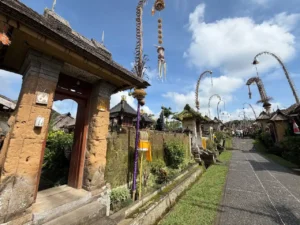
You’ll see penjor everywhere—tall, decorated bamboo poles arching over streets, making ordinary roads look ceremonial. It changes the visual mood of Bali. Like the island put on its good clothes.
Galungan celebrates the victory of dharma over adharma, and it’s tied to the belief that ancestral spirits visit. Kuningan follows, marking their return. You can read that as “two holidays,” but in practice it feels like an ongoing conversation between the living and those who came before.
I’m saying this because it’s easy to treat it like an “attraction.” But if you slow down, you’ll notice something more tender: the way families move together, the way people linger, the way offerings look cared for, not rushed.
And yes, this is where having a simple Balinese festivals calendar overview helps. Not because you want to control it—but because you might want to be present for it without accidentally scheduling three long drives through village roads on the busiest days.
Odalan: The Temple Birthday You Didn’t Know You Were Invited To
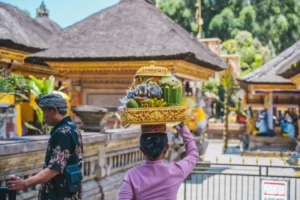
Odalan is where Bali really messes with your sense of “planning,” in the best way. Each temple has anniversary celebrations, and with thousands of temples across the island, this means ceremonies can pop up constantly.
The first Odalan I stumbled into, I wasn’t trying to “find culture.” I was trying to buy snacks. I turned a corner and found a procession, the air smelling like incense and flowers, people dressed beautifully, faces focused but not grim.
I did the awkward tourist thing where you stop too suddenly and pretend you were just casually standing there the whole time. A local man saw my confusion and gestured—just a small hand motion—to stand at the side. That tiny moment of being guided (gently, not scolded) is honestly one of my favorite Bali memories.
This is also why people keep searching Balinese festivals calendar overview online. Odalan dates follow patterns tied to the Pawukon cycle, and they don’t always align with “normal” monthly expectations. You can track them, but you’ll also just… bump into them. And sometimes, bumping into them is better.
The Quieter Days That Don’t Try To Impress You
Not every celebration feels like a parade. Some are low-key from the outside but meaningful inside homes and temples.
Saraswati is a good example. It honors the goddess of knowledge and arts. You might see offerings placed near books or learning tools. That detail sounds small, but it gave me a weird sense of warmth, like the island was saying, “Hey, your mind matters too. Not just your body, not just your money.”
Pagerwesi, focused on spiritual fortification, can feel subtle as well. If you’re expecting loud crowds, you might miss it. If you’re paying attention, you’ll notice the seriousness in routine—people moving with intention, prayers, offerings, family time that feels anchored.
This is the angle that people sometimes forget when they say Balinese festivals like it’s one single thing. Some days are big and public. Some are quiet and private. Both are real.
Planning Without Turning Bali Into A Checklist
Here’s what I’d tell you if we were sitting somewhere with iced coffee and too much sun.
Make room for surprises. Don’t plan every hour. If a ceremony blocks a road, treat it like weather: it’s not personal. It’s just the island doing what it does.
Honestly, having a basic Balinese festivals calendar overview is worth it, at least for major dates like Nyepi and Galungan/Kuningan. It keeps you from accidentally making your life harder—like planning a long transfer on a day when traffic is weird and everything feels extra sacred. But keep the overview light. Think of it as guidance, not control.
And when you’re there, ask people casually. Not “Give me your schedule,” but “Oh, what’s happening today?” The tone matters. Most people respond well to genuine curiosity.
Little Etiquette Notes, The Kind You Whisper To A Friend
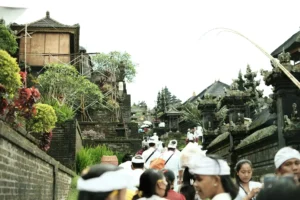
I won’t give you a grand “complete rules list,” because honestly the point is to stay observant. But a few things help:
- If you see a procession, don’t cut through it. Wait at the side. Someone will usually signal when it’s okay to pass.
- If you enter a temple during a ceremony, wear a sarong and sash if required. Often you can borrow or rent them nearby.
- Speak softer than you think you need to. The atmosphere is part of the ritual.
- If you’re unsure where to stand, pause. That tiny pause is often enough for someone to guide you kindly.
Again, it’s not about being perfect. It’s about not treating sacred moments like they exist for your camera roll.
Why You Might Hear The Same Story Twice, And Why That’s Fine
Ending Where I Started: Bali Doesn’t Need You To “Get It” Perfectly
I’m still not an expert. I still hesitate sometimes, especially when I don’t want to accidentally disrespect a moment. But the island doesn’t demand mastery from you. It asks for softness. It rewards patience.
If you travel with curiosity, you’ll find yourself inside Balinese festivals even on days you didn’t plan for. You’ll catch a procession while chasing a coconut. You’ll notice penjor and realize the island is “in season.” You’ll hear music drifting from somewhere you can’t see and feel, for a second, like time has layers.
And honestly—this sounds cheesy, I know—those are the moments that stayed with me. Not the perfect itinerary. Not the “I did all the things.” Just little fragments: incense in warm air, a smile from a stranger, the gentle realization that you can step aside and still be part of the day.