
I used to picture Bali like a clean travel poster: palm trees, a dramatic sunset, maybe a beach club chair that costs too much. Then, on my first full day, I almost stepped on a tiny offering placed right where my foot wanted to land. I stopped so suddenly I felt ridiculous. Like I was auditioning for a role called “polite tourist.”
But it changed something. It made me look down. And then look around. And then, annoyingly, it made me slow down.
That’s how I started understanding cultural activities in Bali—not as scheduled events, but as a steady, quiet presence that keeps showing up while you’re doing ordinary things. Buying water. Cutting through a small alley. Trying to remember which way your homestay is. (You’ll still get it wrong sometimes. I did.)
And I’m going to be honest: for the first couple of days, I kept wanting Bali to explain itself to me. Like the island owed me a neat narrative. It doesn’t. It just keeps going. You’re the one who has to adjust.
The Small Rituals You Notice Before You “Learn” Them
Mornings in Bali feel softer than I expected. Even when scooters start up early, there’s a gentle layer underneath—sweeping, clinking, the faint smell of incense drifting like it’s just part of the weather.
You’ll see offerings on doorsteps and sidewalks. At first they can register as “pretty.” Then you notice how often they appear, and how carefully they’re arranged, and how nobody is making a big deal about it. Which is… kind of the point. It’s not for you. It’s for the day.
This is where Balinese cultural activities for travelers can be misunderstood. People often think it means “join a ceremony” or “book a workshop.” Sometimes it does. But sometimes it just means learning how to exist in a place where sacred and ordinary share the same street. You don’t have to push your way into the center of it. You can simply become a better observer.
I remember standing near a small family compound, watching someone place an offering, and thinking, irrationally, “Should I stop walking? Should I wait?” No one told me to do anything. I just stood still for a second, then walked around. That was all. But it felt like I’d learned a tiny rule.
Not the kind you memorize. The kind your body remembers.
Temples and the Skill of Being “Nearby” Instead of “Inside”
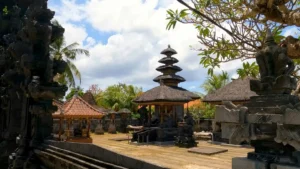
Temples are everywhere, and they’re not all the same kind of experience. Some feel like major landmarks with visitors flowing through. Others feel like they belong to the neighborhood—less “site,” more “space.”
The first time I went to a temple area, I did the classic tourist routine: borrowed a sarong, tied it wrong, untied it, tied it again, still wasn’t convinced. I kept worrying I was standing incorrectly. Which is funny in hindsight, because nobody seemed to care about my awkward stance. They were busy living their lives.
Here’s what helped me relax: I stopped trying to be in the middle of everything. I stayed on the edge, watched quietly, and let the scene be itself. If there was a ceremony, I didn’t treat it like a performance. I didn’t slide closer “just for a better look.” I let distance do its job.
That, to me, is a big part of cultural activities in Bali—learning that witnessing can be respectful, and sometimes better than participating. You can still be curious. You just practice not turning your curiosity into pressure.
And yes, a guide can be helpful for context. But even without one, you can read the atmosphere. The island communicates boundaries pretty clearly when you’re paying attention.
Dance That Doesn’t Ask to Be Liked
I expected traditional dance to be something I “appreciated” politely. Like I’d clap, smile, and then forget it by breakfast.
Instead, it made me sit up straighter.
The eyes are intense—controlled, sharp, almost daring you to look away. The fingers move like they’re speaking. The facial expressions shift quickly, but not randomly. Everything feels precise, practiced, and a little bit intimidating in the best way.
Halfway through my first performance, I realized my shoulders were tense. Not because I was bored, but because I didn’t want to miss details. It wasn’t background entertainment. It demanded attention.
This is why dance keeps appearing in lists of Balinese cultural activities for travelers. And it deserves to. What I didn’t expect is how it follows you after. You leave the venue, but the dance doesn’t really stay there. The next day you might see the same kind of hand flick or shoulder angle in a totally ordinary place—someone practicing in a courtyard, a kid mimicking it, a teacher quietly fixing posture. And suddenly last night’s performance stops feeling like a “show” and starts feeling like one moment from something that’s happening all the time.
You get a second look at the same idea, just from a quieter doorway.
The Sound of Gamelan, and How It Pulls You Off Your Plan
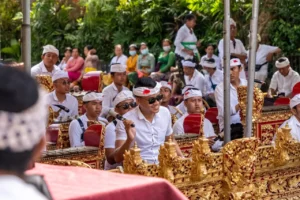
There’s a type of wandering that happens in Bali that I can only describe as “following a sound.” You’re walking, you hear gamelan in the distance—metallic, layered, shimmering—and your body turns before your brain decides anything.
I followed it once down a small side street wearing flip-flops that were one bad step away from snapping. I told myself I was curious. I was also, I think, procrastinating going back to my room. I ended up near a community hall where people were practicing.
I didn’t enter. I stood near the doorway like I belonged there. I did not. Nobody shooed me away, but nobody invited me in either. It wasn’t unfriendly. It was just… neutral. And honestly, that felt fair.
I listened for a while and left quietly.
Moments like that are some of my favorite cultural activities in Bali, even though they don’t look impressive on paper. They’re small. They’re accidental. They’re not optimized for tourism. They feel like you caught real life continuing in front of you.
If you want a more structured version, beginner gamelan sessions exist. Just be ready to feel clumsy. Group rhythm humbles you fast. You’ll think you’re keeping time. You’re not. Then you laugh at yourself and try again.
Making Something with Your Hands and Letting It Be Imperfect
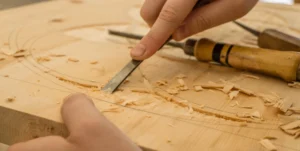
Bali has craft everywhere: carving, silverwork, textiles, painting. It’s easy to reduce that to shopping. But when you sit down and try making something, the whole mood changes.
I tried a carving workshop once. I went in thinking, “This will be relaxing.” Ten minutes later, my piece looked like a potato shaped by mild panic. The instructor didn’t laugh. He corrected my grip, slowed my hand down, and told me to stop fighting the grain. It sounded purely practical, but it landed like life advice anyway.
Workshops like this belong in Balinese cultural activities for travelers not because they’re “authentic” in a marketing sense, but because they move you from spectator to participant. Even if you’re bad at it. Especially if you’re bad at it.
Textile work can do the same. Wax goes where it wants. Dye surprises you. Your plan becomes a suggestion. And you end up with something imperfect that carries the memory of your attention, not just your spending.
I’ll say it twice, from a slightly different angle: when you make something slowly, you start noticing how many things around you were made slowly too. Bali’s crafts stop being décor and become evidence of patience.
Food That Teaches You Without Turning Into a Lecture
I don’t love the “food as deep documentary” tone people use sometimes. Like, yes, food is culture, but food is also just… what you eat when you’re hungry.
Still, Bali teaches through food in quiet ways.
Go to a morning market and you’ll see the engine of the day running: fruit stacked high, spices piled like small mountains, snacks you can’t name but immediately want. People bargain quickly and casually, like it’s a dance they’ve done forever. You’ll point at something, smile, and someone will explain it fast enough that you catch maybe half the meaning. You’ll still taste it. That’s enough.
Cooking classes can be great too—especially the ones that start with ingredients and process rather than plating. They’re often marketed as a cultural add-on, and sometimes that’s accurate because you learn how flavors are built and why balance matters.
I didn’t only learn from “activities,” honestly. A lot of it came from small warungs—sitting there, eating, noticing how things work. Sambal appears without discussion, like it’s simply understood. Meals can be fast and still feel considered. And I love how one dish name can hold different identities. I tried nasi campur twice, on different days in different places, and it felt like the island was showing me two moods under the same title.
Bali repeats itself, but not exactly. Which is, weirdly, comforting.
The Quiet Shift: You Start Moving Differently
Somewhere around day three or four, you might notice you’re walking slower. Not because you’re tired. Because the island keeps giving you reasons to pause.
You look down more. You step around offerings without thinking too hard about it. You wait when a procession crosses the road and it doesn’t feel like an inconvenience. You lower your voice automatically near certain spaces. You don’t always reach for your phone. Sometimes you just watch.
This is the part of cultural activities in Bali that doesn’t fit neatly into an itinerary. It’s not an event. It’s a behavioral shift. A temporary alignment. Not perfect, not “I became local,” just… softer.
And yes, you will see the same things again and again. Offerings. Incense. Music drifting from somewhere hidden. That repetition isn’t boring; it’s how you learn. The second time, you notice different details. The third time, you stop needing to label it at all.
I’m repeating this on purpose: Bali doesn’t teach you through one big moment. It teaches you through many small ones that pile up until your pace changes.
Ending Without Wrapping It Like a Brochure
If you’re going to Bali, don’t try to “complete” it. Pick one or two intentional experiences—dance, a craft workshop, maybe a temple visit with a guide if you want more context—and then leave room for the accidental parts. The parts you can’t schedule.
Because the most honest version of Balinese cultural activities for travelers is often the mix: planned and unplanned, participation and observation, moments where you feel confident and moments where you feel quietly unsure.
And I’ll end with one more repeat, from a final angle: sometimes the best Balinese cultural activities for travelers aren’t the ones you can brag about. They look ordinary. They sound small. But they change how you move for a minute.
That’s when cultural activities in Bali stop being something you “do” and become something you’re briefly allowed to live beside.