
I’m going to be annoyingly honest: the first mornings in Bali can feel like you’ve joined a movie halfway through. You open your eyes and the world is already busy. Not loud-busy like a city that’s trying to prove something—more like… people doing what they do because it’s Tuesday. Or Friday. Or whatever day it is.
Somewhere nearby, a broom is scraping a courtyard. A dog is doing that slow stretch like it’s the landlord. And scooters—always scooters—pass by with this gentle confidence, like they know exactly where they’re going even if you don’t.
If you’ve never been, this is life in Bali for visitors before the “wow” moments show up. No beaches yet, no sunset hunt, no itinerary. Just you, trying to remember if you left your water bottle on the table, and the smell of incense drifting in like it has its own schedule.
When people ask me what daily life in Bali feels like, I usually say: you don’t “start” the day here. You sort of… get admitted into it.
The Sidewalk Teaches You to Look Down (In a Good Way)
You’ll notice the offerings pretty fast. Those small woven trays with flowers, sometimes a little snack, sometimes something that looks random until you learn it’s not random at all. And at first you almost step on them. Like, genuinely almost.
Then your body adapts. You start walking differently—slower, more aware. Not because anyone scolds you. It’s more like your feet learn the rules before your brain does. You stop “charging forward.” You begin to… negotiate with the ground.
I know that sounds dramatic. But it’s not. It’s tiny. It’s just this quiet daily respect built into the pavement.
And yes, it’s part of life in Bali for visitors too, because the island doesn’t give you a handbook. It just puts the lesson where you can’t avoid it: right under your shoes.
Scooters Aren’t Just Traffic, They’re a Language
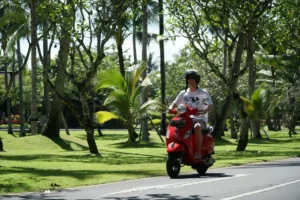
Okay, scooters. I tried to write about Bali without making scooters the main character, but it’s hard. They’re everywhere, and the interesting part is: it doesn’t always feel aggressive. It’s more like the road is a conversation that never stops.
You’ll hear a small beep behind you. Not an angry “MOVE,” more like, “Hey, I’m here, please don’t do anything surprising.” You step aside. They pass. No drama. Ten minutes later, it happens again, and you don’t even flinch.
If you want a weirdly accurate answer to what daily life in Bali feels like, it’s that your nervous system relaxes into the flow. You stop expecting the world to follow strict lines. You start watching people’s eyes, their shoulders, the tiny signals. It’s like traffic is partly intuition.
And then you turn into a narrow lane and suddenly it’s quiet. A little temple entrance. Laundry hanging. A kid practicing dance steps, not in a “performance” way—just repetition, like scales on a piano. You’re lost, but you’re also fine. That happens a lot.
Mid-Morning Errands Become Mini Friendships
Here’s something that surprised me: doing normal errands in Bali can take longer, but not because anyone is inefficient. It’s because people talk. They notice you. Or they notice your confusion and help you out before you even ask.
You go to buy fruit and you end up chatting about mango season. You refill water and someone asks how long you’re staying. You buy sunscreen and the cashier tells you a shortcut to avoid traffic later. It’s not deep, not heavy. It’s just… human.
Sometimes you’re tired and you kind of wish you could do the transaction and disappear. I’m not pretending I’m a perfect socially open person. But often, those little conversations become the thing you remember.
This is life in Bali for visitors when it starts feeling less like “tourism” and more like “okay, I’m existing here for a while.”
Also, quick note: the heat changes your personality. You become a slower version of yourself. And honestly, you might be nicer because of it.
Lunch Is Simple, Until It Isn’t

A warung lunch is one of those things that’s both ordinary and, somehow, memorable. You sit down thinking, I’ll eat and go. Then you look around and realize you’ve been sitting there ten minutes just watching life happen.
There’s usually a fan making a soft clicking sound. Someone’s kid is doing homework at a table that’s slightly too tall. A driver is scrolling his phone with one ear open to the street. The person cooking might be watching TV in the background like it’s no big deal.
And the food—nasi campur, mie goreng, satay—arrives like it’s been doing this job forever. Because it has.
If you ask me what daily life in Bali feels like at lunchtime, it’s not “exotic.” It’s comforting. It’s the feeling of being fed without a fuss. You’re not the center of the room. You’re just another hungry person under a fan.
Also: spice lies. You will say “not too spicy,” and Bali will politely ignore you. Just accept that your forehead may become shiny.
Afternoon Has a Built-In “Nope”
Afternoons can be… blunt. Bali doesn’t really pretend the midday heat is cute. It’s not cute. It’s hot. Your plans start to feel negotiable.
You’ll tell yourself you’re going to do five things. Then you do one and suddenly you’re thinking about shade like it’s a major life priority. You drink water. You sit down. You stare at nothing for a bit.
And I don’t mean in a spiritual way, necessarily. Sometimes you’re just tired. You’re not having a breakthrough. You’re just… slowed down.
I keep coming back to this when describing what daily life in Bali feels like: the island has a rhythm that doesn’t care about your productivity. You can fight it for a few days, but eventually you’ll start planning your life around “when is it cooler” and “where can I sit.”
And somehow that makes you less frantic. Not always. But often.
The Same Street Looks Different Later (And It’s Not Just the Light)
Late afternoon, you see offerings again—fresh ones placed where earlier there were none. You walk the same lane and notice it’s changed. Not dramatically. Small shifts.
A new flower arrangement. A different smell of incense. Someone fixing a gate. Someone washing a motorbike with a seriousness that feels almost ceremonial, even though it’s just washing a motorbike.
This repetition-with-differences is a big part of life in Bali for visitors. You start recognizing patterns: the neighbor who always sweeps at the same time, the dog that barks at scooters but never at people, the shop that suddenly closes because there’s a ceremony.
And you realize—this isn’t “random.” It’s a life that has priorities you’re slowly learning.
Evenings Can Turn Sacred Without Warning
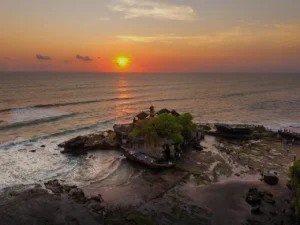
The first time you accidentally walk past a ceremony, you might freeze a little. Not because anyone stops you. It’s because you feel like you’ve walked into something important, mid-sentence.
People in white tops and sarongs. Offerings carried carefully. Faces calm, focused. The air feels different, like it’s been cleaned.
Then—two streets away—someone is grilling corn and laughing with friends. A scooter backfires. A tourist is negotiating for a surfboard rental. And it all exists at once.
This is life in Bali for visitors when you stop seeing “sacred” and “ordinary” as separate zones. They overlap. They share the same sidewalks. The island doesn’t switch costumes for you.
If I’m honest about what daily life in Bali feels like in the evening, it’s layered. You can be moved and then immediately annoyed because your sandals are wet. Both feelings fit.
Rainy Days Are Real Days (Not an Aesthetic)
Not every day is postcard weather. Some days it rains hard enough that your plan becomes “stay near a roof.” Your towel doesn’t dry. Your shoes smell like they’re plotting against you.
Power might flicker. The road might flood in a way that looks dramatic but everyone treats as normal. You’ll see people calmly moving stuff higher, waiting it out, continuing like… yeah, this happens.
I think this is the part people don’t post: damp corners, sudden puddles, the mild chaos of humidity. But it’s still part of what daily life in Bali feels like if you’re here long enough to stop chasing the perfect day.
And weirdly, those rainy days can make you feel more connected to the place. Because it’s not performing for you. It’s just being itself.
When You Start Saying “Tomorrow” Like You Mean It
At some point, you stop trying to “complete” Bali. You stop thinking in highlight reels. You start liking repeat moments.
The same warung auntie recognizing you. The same shortcut alley. The same gentle beep behind you. The same tiny decision to step around an offering instead of over it. You start carrying small cash without thinking. You start timing your errands. You start knowing which road gets messy at certain hours.
And this is probably the nicest version of life in Bali for visitors: not the rush, not the checklist. Just the quiet familiarity that grows when you do normal life things in a place that isn’t yours, but doesn’t push you away either.
If someone asked me again what daily life in Bali feels like, I’d still talk about mornings first. That broom sound. That soft incense smell. That sense that the day has already begun, and you’re simply stepping into it—maybe a little sleepy, maybe a little unsure, but present.
And then you’ll do it again tomorrow. Not because you’re maximizing the trip. Just because… tomorrow happens.