
You know that thing where you tell yourself, “Just a day trip,” like you’re being responsible? And then the day stretches. Not in a dramatic movie way. More like elastic—quietly—and you don’t notice until it’s already evening and you’re still not ready to go back.
That was my first East Bali experience. I was trying to be efficient (why do we do that on vacation?) and I had this tidy little plan in my head. See a few places, take a couple photos, be home for a shower that doesn’t involve sand, the end.
Then I took a wrong turn.
Not a big heroic wrong turn. Just the kind where you slow down and squint at the road and think, “Wait… is this still the road?” The scenery got quieter. Not necessarily “more beautiful” in the postcard sense. Quieter. And something about that made me trust it.
So, okay—this is my East Bali travel guide. Not the polished “Top Ten” version. More like what I’d text you at midnight after getting back, half-asleep, still tasting salt and incense, trying to explain why a place felt like it had a pulse.
If you’re coming for culture—old stone, rituals that are still alive, that sense you’re witnessing something real and not staged—then you’ll want a slightly different lens. That’s where East Bali travel guide for cultural sites comes in for me. Not as a checklist. More like a reminder: stop grabbing, stop rushing, stop treating everything like a trophy.
Also: I repeat myself when I’m excited or unsure. That’s going to happen. Sorry in advance. Or not sorry. It’s kind of the point.
The Drive East Is Part Of It, Even When It’s… Honestly A Bit Boring

From the south—Seminyak, Canggu, all those places that run on iced coffee and traffic—you pay for East Bali with time. There’s no clever hack. You can ride fast, sure, but then you arrive with that tight chest feeling like you’ve been arguing with the clock the whole way.
If you can, stay at least one night. Two is better, but one already changes the texture of the trip. You wake up and it’s not loud. Not empty. Just… not loud. You might hear a scooter far away, a rooster doing its daily announcement, someone sweeping a yard like it’s a sacred task (and maybe it is). There’s relief in that. Real relief.
And weirdly, I think that relief belongs inside an East Bali travel guide because it’s part of the value. The “doing nothing” moments aren’t filler. They’re the reason you went.
Sometimes I catch myself trying to “use” the morning, like I’m afraid it will evaporate if I don’t optimize it. East Bali has a way of gently embarrassing that impulse. You sit with coffee, you watch the light shift. You pretend you’re waiting for someone, even if you’re not. And you let a few minutes be… kind of pointless.
Pointless in a good way.
Temples Aren’t Attractions First. They’re Active. They’re Happening.
Let’s talk temples, because people always do, and because you probably will end up at one even if you don’t mean to.
Pura Lempuyang is the obvious name. The famous gates. The lines. The photos where the ground looks like a mirror (and then you learn it’s often a little trick with glass, and somehow it’s still fun, like finding out how a magic trick works). It can be beautiful. It can also feel crowded. Both can be true at the same time, which I weirdly appreciate.
Here’s the part I wish someone had said to me without sounding strict: if you walk in with the energy of “I’m here to get mine,” the place kind of… closes. Not violently. Just quietly. Like it refuses to meet you where you are.
If you go softer—sarong on, shoulders covered, voice low, eyes actually paying attention—you start noticing the parts that don’t show up in the iconic photo. Tiny offerings. The smell of incense that appears and disappears. People moving with purpose, not for content, not for you.
This is where East Bali travel guide for cultural sites matters in a real, practical way. Cultural sites aren’t museums. A lot of them are still in use. So your job isn’t to consume them. Your job is to stand at the edge of the scene without cracking it.
And I’m not pretending I’m perfect at this. I’ve spoken too loudly before. I’ve stood in the wrong place because I didn’t understand the flow. Then you see someone praying and you get that quiet internal “oh.” You adjust, you don’t make it a big dramatic guilt moment. You just… adjust.
Besakih can be part of the same day, depending on your route. It’s big. Sometimes busy. You might get approached by guides and ou can say no politely. You can also say yes if you want context. I’ve done both. My decision-making is not always consistent, because sometimes my brain is awake and sometimes it’s just… a potato with sunscreen.
And that’s okay. East Bali is forgiving if you’re respectful.
Water Palaces: Where Your Thoughts Wander Off Without Asking Permission
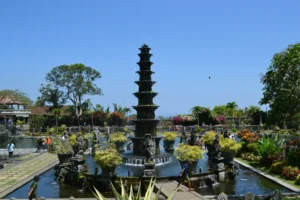
Tirta Gangga is one of those places that slows you down without explaining why. Pools, gardens, stepping stones—everything designed around water, and water is basically the opposite of hurry.
Go early if you can. Morning there feels like the place is still stretching awake. Light sits on surfaces differently. You hear water, birds, footsteps. Not much else.
I once watched koi for way too long. I’m not even a “fish person.” But the fish had this calm confidence and I was—this sounds ridiculous—slightly jealous. Like, wow, you are so certain of your little life.
East Bali does that. It makes you notice small emotions you usually don’t name because you’re too busy naming your next destination. That’s why Tirta Gangga often feels less like a checklist stop and more like a quiet chapter you didn’t know you needed in an East Bali travel guide.
Taman Ujung, nearby, feels different. More open, more sky, more distance. Less cozy, more breathe. If you’re with a friend, this is where you might suddenly talk about something you didn’t plan to talk about. The space sort of… invites honesty. Or maybe it just gives your brain room to stop performing.
If you’re building a day around East Bali travel guide for cultural sites, I’d keep both water palaces in mind because they’re not duplicates. Same category, different mood. Tirta Gangga feels intimate. Taman Ujung feels wide and slightly lonely in a beautiful way.
And here’s the funny part: you might leave thinking, “Okay, we did water palaces,” then later—hours later—you’ll still be thinking about the sound of water on stone. Same idea returning, different angle. Repetition again. I warned you.
A Village Visit That Feels Real… If You Behave Like A Guest (And Accept A Little Awkwardness)
If you want culture that isn’t framed as “a thing to see,” consider stopping in a traditional village like Tenganan, known for weaving traditions and the geringsing textile.
But I want to say this gently: places like this can feel uncomfortable if visitors treat them like a display. The good version of a village stop is quiet, respectful, and honestly a bit awkward. Awkward is useful. Awkward means you haven’t turned people into props.
Ask before taking close photos. Move slowly. Buy something only if you genuinely want it—not to relieve guilt, not as a performative “support” moment. If someone explains something, listen like you mean it, even if you don’t fully understand the first time. Especially if you don’t.
This is a big reason I like East Bali: it forces me to notice my own habits. I can be impatient. I can be too goal-driven. East Bali doesn’t reward that. It doesn’t punish it either. It just stays itself, and you either meet it there or you don’t.
And yes, I’ll say it again from another angle: East Bali travel guide for cultural sites is less about collecting “sites,” more about learning how to approach living culture without grabbing at it. Sometimes the “cultural moment” is just a short conversation, a pattern being explained, a smile that says, “Yes, you can stand here—just don’t be loud.”
After a village stop, I like to eat somewhere simple—warung food that isn’t curated. You point at what you want, you sit, you drink something cold. You stop being a tourist for a second and become a hungry human. It’s grounding.
The Coast: Not Always Postcard-Pretty, But It Sticks In Your Head Anyway
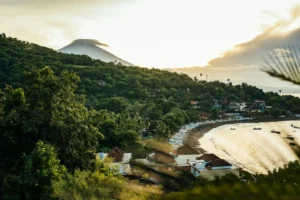
Amed is the name people usually throw out when they talk about East Bali coast time, and yeah, it makes sense. Clear water, snorkeling, diving, that relaxed salt-air mood. But even if you don’t dive, the coastline can feel… honest. Sometimes darker sand. Sometimes a rougher shore. Boats that aren’t decorative—they’re working. And Mount Agung, when it shows up, feels like a presence watching everything without needing to say anything.
I once planned a sunrise viewpoint and got clouds instead. Thick ones. No dramatic light. No “moment.” I was annoyed for about a minute (because I’m me), then I felt oddly relieved. Like the mountain was saying, “You don’t always get what you came for.”
That’s another thread in this East Bali travel guide: the best moments aren’t always the ones you can schedule. Sometimes you get the opposite of what you planned, and it becomes the memory that lasts.
Also, you might drive the same road twice. Once you’re focused on the next stop. Later you drive it again slower, noticing a shrine you missed, or a view you didn’t register. Same road, different mind. It makes travel feel less like consumption and more like… returning.
Practical Stuff, But Not The “Complete Package” Kind (Because I Don’t Trust That Tone)
A few things that help, casually—like I’m telling you while we’re standing by a motorbike, adjusting helmets, already a bit sweaty:
Transport: scooters are great if you’re confident, but East Bali roads can be narrow and curvy, and surprises happen (dogs, potholes, ceremony traffic, trucks that take corners like they own physics). If you’re unsure, hiring a driver for a day isn’t “cheating.” It’s protecting your mood. Mood matters more than people admit.
Temple clothing: bring something that covers shoulders and knees. You can borrow sarongs, but having your own feels easier, less last-minute.
Timing: mornings are calmer. Not because “perfect light,” but because places feel less pressured. You can stand quietly without feeling like you’re blocking someone’s shot.
Cash: keep small bills. Not everywhere is card-friendly, and sometimes you just want coconut water from a roadside stand, not a whole plan.
If you’re mapping your days around East Bali travel guide for cultural sites, don’t stack too many “important” places into one day. Two meaningful stops can be plenty, especially if you leave room for slow moments—coffee, a viewpoint, a random ceremony you watch from a respectful distance.
And if you catch yourself thinking about the same place again—Tirta Gangga, Taman Ujung, Lempuyang—don’t fight it. East Bali has this looping effect. The same idea comes back with different weather.
The Ending That Isn’t Tidy (Because East Bali Isn’t Tidy)
I can’t give you a clean ending like “and then you’ll have the perfect trip.” That’s not how it feels. East Bali is a place you keep understanding in layers. You go, you see things, you think you “get it,” and then later you remember a tiny detail—an offering, a quiet smile, the sound of water—and you realize that detail was the real point.
So if you take one thing from this East Bali travel guide, let it be this: don’t rush the east. Let it be inefficient, let it interrupt you. Let yourself be slightly lost sometimes. Not unsafe-lost—just… unplanned.
And if your main reason for going is culture—temples, water palaces, traditions that are still alive—keep East Bali travel guide for cultural sites close, not as a rigid plan, but as a reminder to be gentle in places that don’t belong to you.
You’ll come back with photos, sure. But you’ll also come back with that hard-to-explain feeling—like you were briefly allowed into a quieter version of Bali, and you didn’t want to speak too loudly while you were there.